Best German Language Institute Near Me: How Do You Master German Noun Genders and Case Agreements?
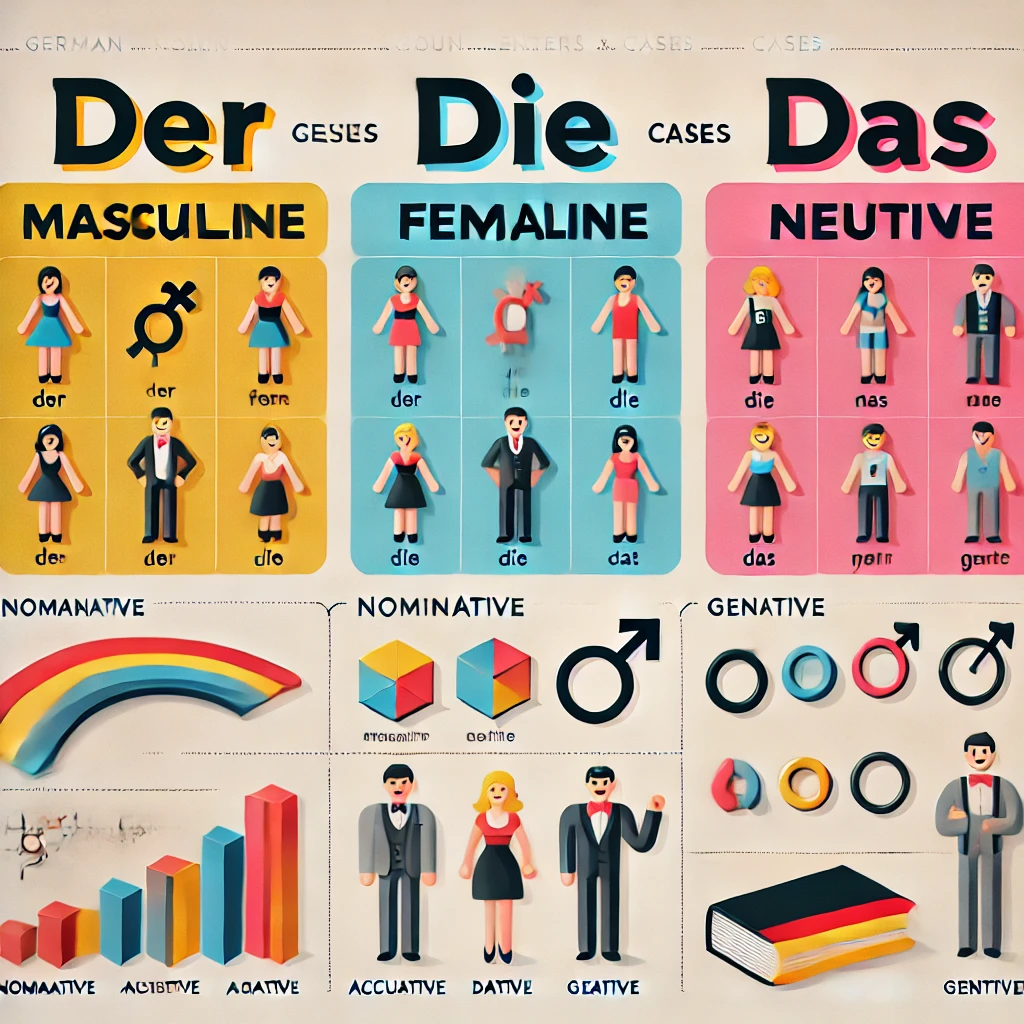
Best German language institute near me – if you’re looking for the right place to improve your German skills, you’ve come to the right guide! Finding the best German language institute near me can make a significant difference in mastering the language efficiently. Learning German can be challenging, especially when dealing with noun genders and case agreements. Unlike English, German nouns fall into three categories: masculine (der), feminine (die), and neuter (das). Additionally, cases—nominative, accusative, dative, and genitive—affect articles and adjective endings. Mastering these concepts is essential for fluency, and with the right techniques, you can make significant progress. So, how can you master these?
How Do You Remember German Noun Genders?
Memorizing noun genders can be tricky, but here are some effective strategies:
Use mnemonics – Associate nouns with memorable images. For example, picture a lion (“der Löwe”) wearing a crown to remember it’s masculine.
Group similar nouns – Learn words in categories, like furniture: “der Tisch” (table), “der Stuhl” (chair), and “der Schrank” (cupboard).
Learn common suffix patterns:
Masculine: -er, -en, -ig (e.g., der Lehrer, der Wagen)
Feminine: -heit, -keit, -ung (e.g., die Freiheit, die Regierung)
Neuter: -chen, -lein, -ment (e.g., das Mädchen, das Instrument)
Use color-coded flashcards – Assign colors to each gender to reinforce visual memory.
How Can You Master German Case Agreements?
Cases determine the form of articles, adjectives, and pronouns. Here’s how to simplify them:
Understand case roles:
Nominative: Subject (Der Hund schläft – The dog sleeps).
Accusative: Direct object (Ich sehe den Hund – I see the dog).
Dative: Indirect object (Ich gebe dem Hund Futter – I give the dog food).
Genitive: Possession (Das ist das Haus des Mannes – That is the man’s house).
Practice sentence structures – Create simple sentences using each case.
Use charts and tables – Keep a reference for quick review.
Engage in active speaking and writing – The more you use the language, the more natural it becomes.
Final Thoughts
By using memory techniques, structured practice, and immersion, mastering German noun genders and cases becomes much easier. Stay consistent, practice regularly, and reinforce learning through reading, writing, listening, and speaking. With patience and dedication, German grammar will feel like second nature!
Happy learning! Viel Erfolg!